




















Blog

Building a Data-Driven Wealth Management Practice: The Role of a Unified Data Warehouse

Written by Tim Highland, | Updated on June 23, 2026

Why wealth management firms need a single source of truth — and how AI-powered data aggregation makes it achievable

The Data Problem in Wealth Management

Wealth management firms operate in one of the most data-intensive environments in financial services. Client data flows from custodians, portfolio management systems, CRMs, compliance platforms, document repositories, banking cores, and insurance systems — often in incompatible formats, on different update schedules, and with no central mechanism for reconciliation.

The result is chronic data fragmentation. Advisors work with incomplete information. Operations teams spend hours reconciling inconsistencies. Risk officers lack the comprehensive visibility needed for effective oversight. And the AI and analytics investments firms want to make cannot reach their potential without a clean, unified data foundation.

Data fragmentation is not just an IT problem — it is a revenue problem. Advisors who lack a complete client view miss cross-sell opportunities, deliver inconsistent advice, and lose clients to better-informed competitors.

What Is a Wealth Management Data Warehouse?

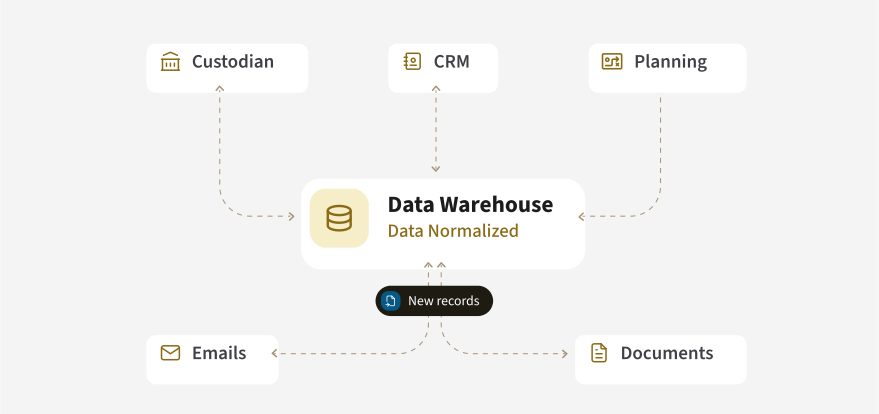
A data warehouse in the context of wealth management is a centralized repository that ingests, normalizes, and stores data from across the firm’s technology ecosystem. Unlike operational systems, which are optimized for transaction processing, a data warehouse is designed for analysis — enabling advisors, managers, and executives to query and act on comprehensive information without touching production systems.

Modern wealth management data warehouses go beyond traditional storage. They incorporate AI-driven extraction, real-time and batch processing capabilities, and domain models specifically designed for the complexity of wealth, banking, and insurance data. They support not just structured records but also semi-structured and unstructured data — forms, PDFs, emails, voice notes, and documents of all types.

Key Architecture Components

Universal Domain Model

A universal domain model is a pre-built data schema that maps common wealth management concepts — client, account, household, portfolio, transaction, advisor, product — across all connected systems. Rather than building custom integrations for every data source, firms connect to a single model that normalizes data regardless of source format.

AI-Powered ELT Framework

Modern data warehouses use an Extract, Load, Transform (ELT) architecture where AI automates data extraction from diverse sources, accelerates transformation logic, and enforces data quality rules — reducing the time from data ingestion to actionable insight from days to minutes.

Pre-Built Connector Library

Out-of-the-box integrations using APIs, RPA, and file-based connectors enable plug-and-play connectivity with major custodians, account processing cores, CRM platforms, document management systems, and KYC solutions — without custom development.

Real-Time and Batch Processing

The most sophisticated platforms support both real-time data streaming for time-sensitive advisor and client interactions, and batch processing for high-volume overnight operations — ensuring that the right data is available at the right time for every use case.

From Data Warehouse to Advisor Intelligence

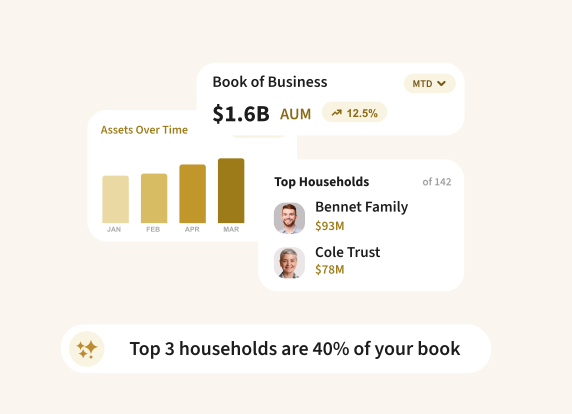
A data warehouse is most valuable not as a technical infrastructure asset but as the engine that powers advisor intelligence. When data is unified, normalized, and accessible, firms can build the workflows, dashboards, and AI capabilities that transform how advisors serve clients.

Data CapabilityAdvisor Outcome
360-degree client viewComplete picture of every client relationship across all accounts and products
Real-time portfolio dataInstant access to performance, allocation, and risk metrics
Cross-system data reconciliationEliminate discrepancies between CRM, custodian, and portfolio data
AI-powered analyticsPredictive insights for rebalancing, cross-sell, and churn prevention
Unstructured data processingExtract insights from emails, documents, voice notes, and PDFs

JIFFYAI’s Data Warehouse and Data Aggregation Solutions

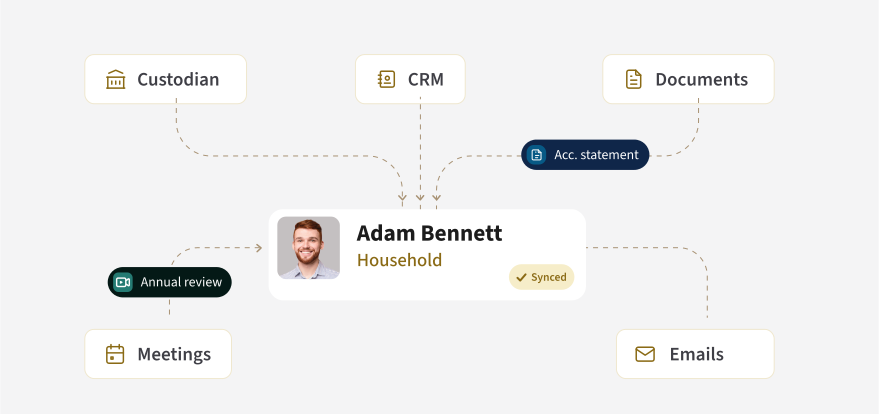
JIFFYAI’s Data Warehouse and Data Aggregation solutions bring together all data types from across custodians, core systems, CRMs, and document platforms into a single trusted source. Powered by AI-driven automation, they convert raw data into real-time actionable insights and deliver them directly to advisors through a unified interface.

  • Unified data foundation:  delivering a true 360-degree client view across wealth, banking, and insurance.
  • Seamless no-code integrations:  for real-time and batch data flow from all major platforms.
  • AI-powered extraction and analytics:  driving faster and smarter advisor decisions.
  • Enterprise-grade security and data quality:  with built-in governance and compliance controls.
  • Extensibility to machine learning and data lakes:  for advanced predictive analytics and deep storage.

Explore how JIFFYAI can help your advisors overcome data silos and gather growth-oriented insights when and where they need. Visit Data Warehouse and Aggregation Page.

Unlock the potential of AI-powered transformation in Data Warehouse and Aggregation