





















How structured document management practices protect wealth management firms during regulatory examinations and support operational excellence
Why Document Management Is a Strategic Priority
Financial advisors generate and receive an enormous volume of documents in the course of serving clients: account applications, investment policy statements, financial plans, trade confirmations, client correspondence, compliance disclosures, suitability records, and more. How these documents are stored, organized, and retrieved has significant implications for regulatory compliance, operational efficiency, advisor productivity, and — ultimately — client outcomes.
Poor document management is not just a filing inconvenience. It is a regulatory liability. When examiners request records and firms cannot produce them promptly and completely, the consequences range from citation notices to significant fines. When advisors cannot find client documents they need during client interactions, service quality suffers. And when firms undergo advisor transitions or corporate transactions, document chaos can delay or derail the entire process.
Regulatory Requirements for Document Retention
Broker-dealers, registered investment advisers (RIAs), and other wealth management firms operate under detailed document retention requirements established by FINRA, the SEC, and relevant state regulators. These rules specify not just what documents must be retained, but for how long, in what format, and with what controls.
Key retention categories:
- Account records — customer account information, agreements, and account maintenance records. Generally retained for 6 years under FINRA Rule 4511.
- Business communications — correspondence and communications related to the firm’s business, including email and electronic messages.
- Order records and confirmations — records of orders, trade confirmations, and execution documentation.
- Financial records — general ledger, trial balances, income records, and expense records.
- Compliance and supervision records — supervisory procedures, exception reports, and compliance review documentation.
Digital document management systems that automatically apply retention rules, flag documents approaching their retention limits, and enforce destruction policies reduce the compliance burden of retention management significantly — while providing a defensible audit trail of retention compliance itself.
What Document Audit Readiness Means in Practice
Audit readiness is the ability to respond to a regulatory examination or internal audit request promptly, completely, and confidently. A truly audit-ready firm can produce any requested document within hours, provide complete context for every client interaction, demonstrate systematic compliance with supervision requirements, and show a clean chain of custody for all records.
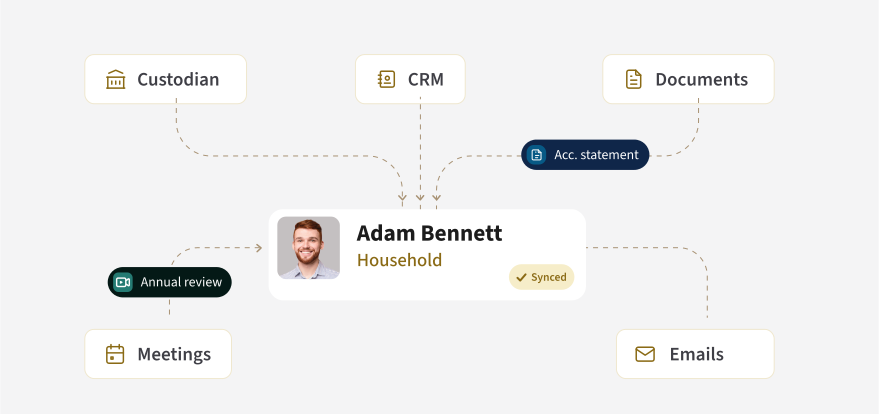
Achieving this standard requires more than just storing documents. It requires structured metadata that enables search and retrieval, version control that maintains document history, access controls that enforce security while enabling authorized retrieval, and integration with the systems that generate documents so that records are captured automatically rather than depending on manual filing.
The difference between a firm that passes a regulatory examination and one that receives a deficiency notice is often not the underlying compliance record — it is the ability to demonstrate that record quickly and completely.
AI-Powered Document Management: Beyond the Filing Cabinet
Intelligent Document Classification
AI-powered document management systems automatically classify incoming documents by type, client, advisor, and relevant regulatory category — without manual tagging. This ensures that every document is consistently organized and retrievable, regardless of how it entered the system.
Full-Text Search and Contextual Retrieval
Modern document platforms support full-text search across all document content — not just file names or manually applied tags. An advisor or compliance officer can search for a client’s name, an account number, a date range, or a specific term and retrieve all relevant documents instantly, regardless of document type or format.
Automated Retention Policy Enforcement
Retention rules are applied automatically at the document level, with configurable policies by document type and regulatory category. Documents approaching their destruction dates are flagged for review, and destruction events are logged with the date, document type, and approving authority — creating a defensible record of retention compliance.
Integration with Advisor Workflows
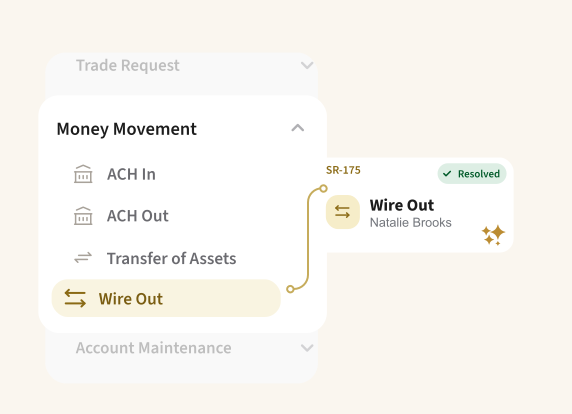
Document management delivers the greatest value when it is embedded in the advisor’s daily workflow rather than operating as a separate system. When the advisor desktop, onboarding platform, and servicing tools all automatically file documents to the central repository, the burden of document management shifts from advisors to the platform — and completeness improves dramatically.
How JIFFYAI Integrates Document Management with the Advisor Experience
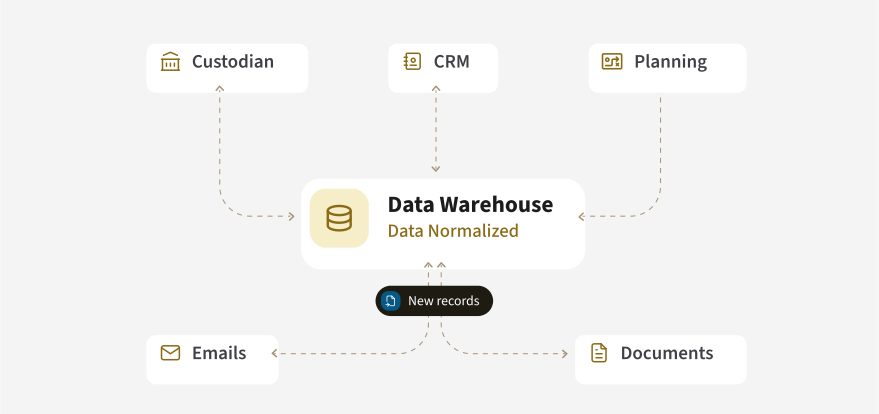
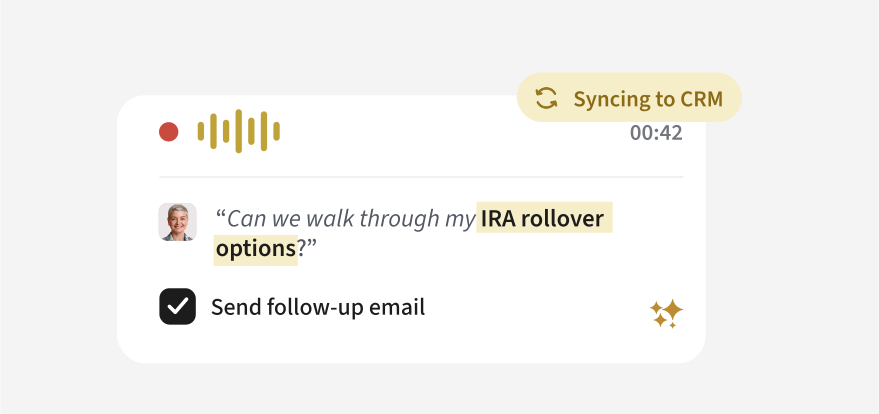
JIFFYAI’s Engagement AI suite processes all document types — structured forms, PDFs, emails, scanned documents, and voice notes — into a unified Data Warehouse, creating a searchable record of all client-related documentation. Documents generated through the Client Onboarding and Account Servicing workflows are automatically filed with complete metadata, creating an audit-ready record without any manual filing effort.
| Document Type | How JIFFYAI Handles It | Compliance Benefit |
|---|---|---|
| Account applications | AI extraction and automatic filing with full metadata | Complete, searchable account opening records |
| Client correspondence | Ingestion and classification from email and messaging | Systematic communication archive |
| Compliance disclosures | Workflow-driven generation and acknowledgment capture | Documented evidence of required disclosure delivery |
| Meeting notes and summaries | AI Companion auto-capture from advisor interactions | Consistent interaction documentation without manual entry |
| Financial plans and proposals | Version-controlled document management with client linking | Complete planning history with change audit trail |
Learn how JIFFYAI can help your firm achieve and demonstrate audit readiness across all document types — visit jiffy.ai/wealth-management.