





















Understanding NIGO, why it costs wealth management firms millions, and how AI-powered onboarding eliminates it at the source
What Does NIGO Mean?
NIGO stands for Not-in-Good-Order. In the wealth management industry, a NIGO occurs when a submitted document, form, or application contains errors, omissions, or inconsistencies that prevent it from being processed. The submission is returned to the submitting party — typically the advisor or the client — for correction before it can proceed.
NIGOs are most common in account opening, account maintenance, transfer forms, and any process that requires structured data submission to a custodian, clearing firm, or processing system. Every NIGO represents a failed submission that must be identified, communicated, corrected, and resubmitted — adding cost, time, and frustration at every step of the process.
Industry estimates suggest that NIGO rates in paper-based wealth management onboarding environments commonly run between 20% and 40% of all submissions — meaning that nearly one in three account applications is rejected before processing even begins.
The True Cost of NIGO in Wealth Management
Direct Operational Costs
Every NIGO event triggers a sequence of operational steps: the processing system or custodian identifies the error, the operations team logs and communicates the rejection, the advisor or client corrects the issue, the form is resubmitted, and the processing queue starts over. Each of these steps consumes staff time, generates operational overhead, and delays account activation — with direct costs estimated at $50 to $100 per NIGO event or more, depending on the complexity of the correction required.
Revenue Delay and Client Experience Impact
Every day an account is stuck in NIGO resolution is a day that client assets are not in the firm’s custody generating advisory fees. For a firm opening hundreds of accounts per month, even a 48-hour average NIGO delay across a 25% NIGO rate represents a measurable drag on revenue. More significantly, clients experiencing repeated correction requests during onboarding begin their advisory relationship with a negative impression that is difficult to reverse.
Advisor Productivity Loss
Advisors who spend time tracking down NIGO errors, calling clients to collect missing information, and resubmitting corrected applications are not meeting with clients, prospecting, or delivering advice. NIGO management is one of the most significant contributors to advisor administrative burden — and one of the most solvable with the right technology.
Custodian Relationship Risk
Custodians track NIGO rates at the firm level. Firms with persistently high NIGO rates may face additional scrutiny, slower processing priority, or operational support consequences. Maintaining a low NIGO rate is not just an internal efficiency goal — it is a factor in the firm’s standing with its operational partners.
| NIGO Impact Category | Typical Effect | Scale for a Mid-Size Firm |
|---|---|---|
| Per-event operational cost | $50–$100 in staff time per NIGO | $250K–$500K annually at 25% NIGO rate |
| Account activation delay | 2–5 additional business days per NIGO | Weeks of delayed revenue across monthly volume |
| Advisor time lost | 30–60 minutes per NIGO resolution | Hundreds of hours per year across advisor team |
| Client satisfaction impact | Negative first impression at onboarding | Measurable reduction in early asset consolidation |
| Repeat submission risk | Corrections sometimes introduce new errors | Cascading NIGO cycles on complex accounts |
The Most Common Causes of NIGO
Missing or Incomplete Fields
The single most common cause of NIGO rejections is simply that required fields are left blank. In paper-based and legacy digital environments, there is no mechanism to prevent submission of an incomplete form. The error is only discovered after the custodian or processing system reviews the submission — by which point significant time has already elapsed.
Signature Errors and Missing Authorizations
Many account forms require signatures in multiple locations, with specific date requirements, initials, or joint account co-signer signatures. Missed signatures — even on a single line of a multi-page form — result in rejection of the entire submission. In paper environments, this is a frequent and frustrating source of NIGO events.
Data Format and Consistency Errors
Date fields entered in the wrong format, Social Security Numbers with incorrect digit counts, addresses that do not match identity documents, and beneficiary percentages that do not sum to 100% are all common sources of form rejections. These errors are entirely preventable with real-time validation — but invisible in paper-based submission processes.
Outdated or Incorrect Forms
Custodians and processing firms periodically update their required forms. Advisors using old form versions — whether stored in a desk drawer, a shared drive folder, or a legacy document management system — submit applications on outdated templates that are automatically rejected. In environments without centralized form management, this is a persistently common NIGO source.
Suitability and Regulatory Mismatches
Account applications that request investment products or account types inconsistent with the client’s stated risk tolerance, investment objectives, or regulatory eligibility may be rejected for suitability or compliance reasons. Without automated suitability checks at submission, these errors are only caught downstream — after the form has been submitted and reviewed.
How AI-Powered Onboarding Eliminates NIGO at the Source
The most effective NIGO reduction strategy is prevention — building validation logic into the submission process so that errors are caught and corrected before the form ever reaches the custodian or processing system. AI-powered onboarding platforms achieve this through multiple layered mechanisms:
Real-Time Field Validation
Smart digital forms validate every field as it is completed — checking format, completeness, and logical consistency in real time. Advisors and clients receive immediate feedback when something is missing or incorrectly formatted, rather than discovering the error after submission. Forms cannot be submitted until all validation checks pass, eliminating blank-field rejections entirely.
Intelligent Data Pre-Population
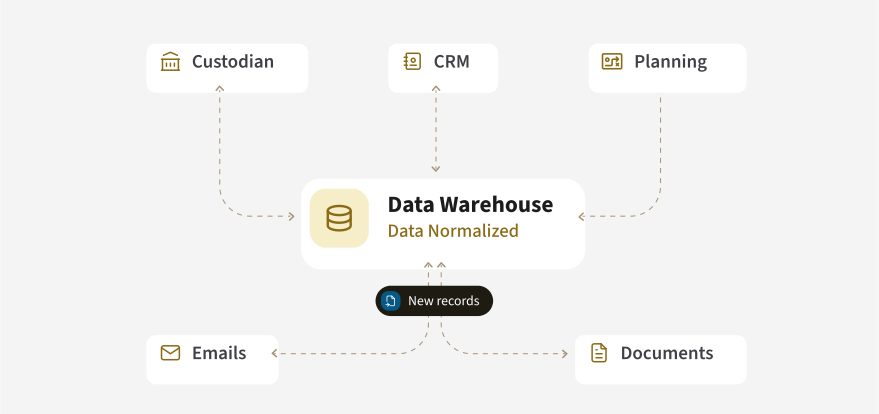
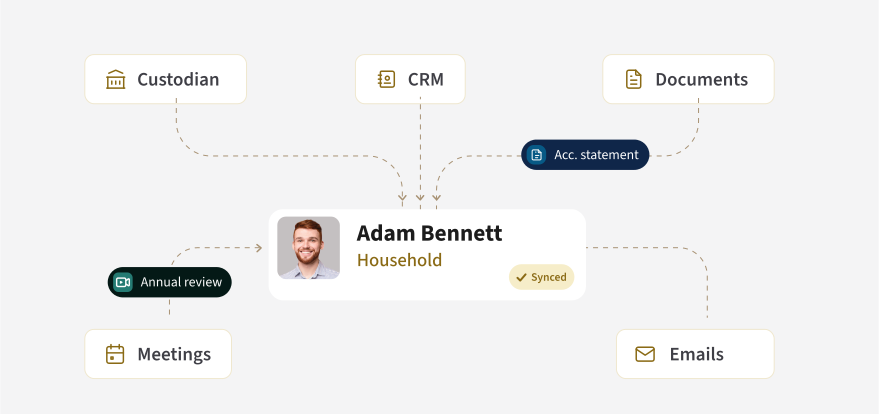
AI-powered onboarding platforms pre-populate known client data from CRM systems, existing account records, and identity verification results — reducing the volume of manual data entry and the associated error rate. When the system already knows the client’s name, address, SSN, and investment profile, the advisor and client only need to confirm and supplement rather than enter from scratch.
Custodian-Specific Requirement Validation
Different custodians have different form specifications, data requirements, and processing rules. Leading platforms maintain current custodian requirement libraries and validate submissions against the specific custodian’s rules before submission — catching custodian-specific rejections before they occur rather than after.
Digital E-Signature with Guided Completion
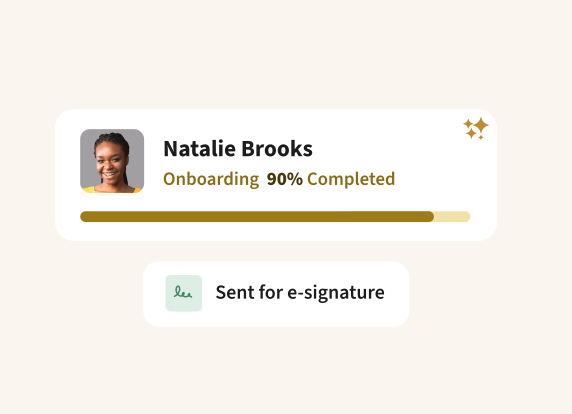
Digital signature workflows guide signers through every required signature location in the correct sequence, with automatic reminders for co-signer actions and completion tracking. It is structurally impossible to miss a required signature in a properly configured e-signature workflow — eliminating the most common paper-based NIGO category entirely.
Always-Current Form Libraries
Centralized digital form libraries are maintained and updated automatically when custodians and processing firms release new form versions. Advisors always submit on current forms without needing to manage version control manually — removing outdated form submissions as a NIGO source entirely.
How JIFFYAI Drives NIGO Rates Toward Zero
JIFFYAI’s Unified Onboarding solution is purpose-built to eliminate the conditions that produce NIGO events. Real-time validation logic, AI-powered data pre-population, guided digital signature workflows, and pre-built custodian integrations work together to ensure that every submission is complete, accurate, and compliant before it leaves the platform.
| NIGO Cause | How JIFFYAI Prevents It |
|---|---|
| Missing or incomplete fields | Real-time validation prevents form submission until all required fields are complete |
| Signature errors | Guided e-signature workflow ensures every required signature is captured in sequence |
| Data format errors | Inline format validation catches SSN, date, and address errors as they are entered |
| Outdated forms | Centralized, automatically updated form library ensures current custodian versions always |
| Suitability mismatches | Automated suitability checks flag inconsistencies before submission |
| Beneficiary percentage errors | Logic validation confirms beneficiary allocations sum correctly before submission |
| Cross-field inconsistencies | AI cross-field validation catches logical conflicts across the entire application |
NIGO Tracking and Analytics
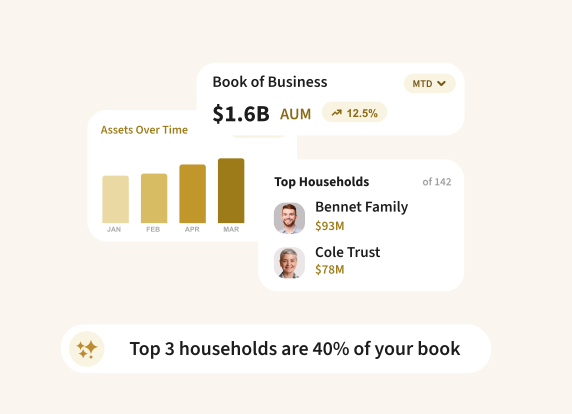
Beyond prevention, JIFFYAI provides real-time NIGO tracking and analytics that allow operations managers to monitor rejection rates by account type, advisor, custodian, and error category. This visibility enables continuous improvement — identifying any remaining error patterns and closing them systematically — and provides the metrics needed to demonstrate operational performance to firm leadership and regulatory examiners.
- NIGO rate by advisor — identify individual training needs and coaching opportunities.
- NIGO rate by account type — pinpoint form or process design issues specific to certain products.
- NIGO rate by custodian — track custodian-specific rejection patterns and address them proactively.
- Average resolution time — measure how quickly NIGO events are resolved when they do occur.
- NIGO cost per period — quantify the operational cost impact and track ROI from reduction initiatives.
To see how JIFFYAI’s Unified Onboarding platform can drive NIGO rates to near-zero across your account opening and servicing workflows, talk to our experts or visit jiffy.ai/wealth-management.