Written by Penny Phillips, President and Co-Founder of Journey Strategic Wealth | Updated on June 18, 2025

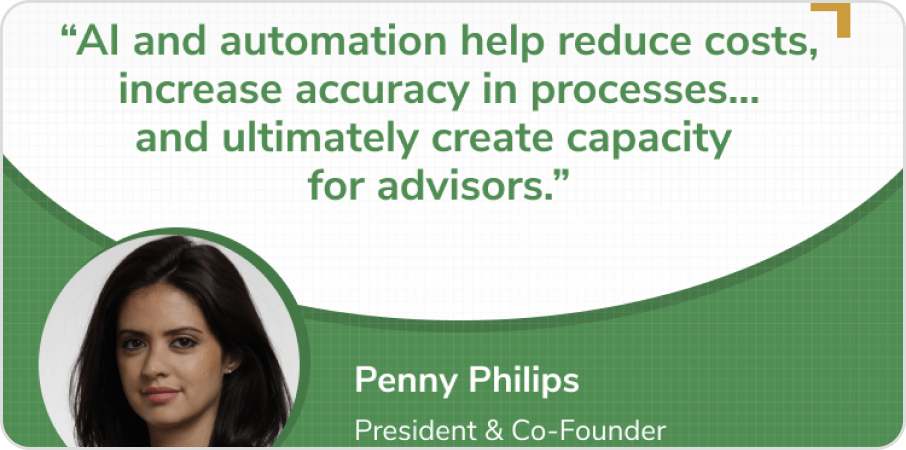
We cannot emphasize enough the impact that artificial intelligence (AI) and automation (specifically Robotic Process Automation) has had, and will continue to have, on our industry. In fact, most advisors have grown so accustomed to their benefits, that they may not even realize the daily impact to their practices and clients. Consider your custodial platform and the way a client’s information seamlessly prepopulates in the system if he/she/they already has an account there. Or think about quarterly performance reporting; with the push a few buttons, you can generate reports for every single household in just a few minutes. AI and automation help reduce costs, increase accuracy in processes (like account opening) and ultimately create capacity for advisors, conceivably leading to increased revenue and profits.

There are challenges, however, that individual advisors face as it relates to embracing this new age of technology and fully automating their operations. First of all, some advisors are not yet reaping the full benefits; advisors within larger institutions are oftentimes limited to the systems and tools available at their home firm, many of which are siloed, fragmented, and outdated. 

Advisors who CAN build their own tech stack often struggle with “technology overload” and feel paralyzed by the many options and customizations.  In addition, training staff can be challenging. Even with access to the best operational tools, many advisory teams still use excel spreadsheets to manage and analyze data about their practices.  Finally, redeploying human capital towards revenue-generating activities is no easy feat. Work expands to fill the time we have to complete it, so ironically, just because capacity has been created, does not necessarily mean the time will be filled with productive work.

Unlock the potential of AI-powered transformation. Talk to one of our experts today.

Topics: Artificial Intelligenceautomationfinancial serviceintelligent automationRobotic Process AutomationRPA
Written by Lori Hardwick, CEO, Wealth Tech, Red Rock Strategic Partners, LLC., CEO, Wealth Tech, Red Rock Strategic Partners, LLC. | Updated on May 7, 2025

While digital transformation has recently become a key priority for the financial services sector, last year was a landmark period in this journey. Nearly half (49%) of firms have accelerated their initiatives, finds Deloitte, and the financial services sector has far outpaced other industries in their digital investments (arguably,  because our industry was so far behind others).

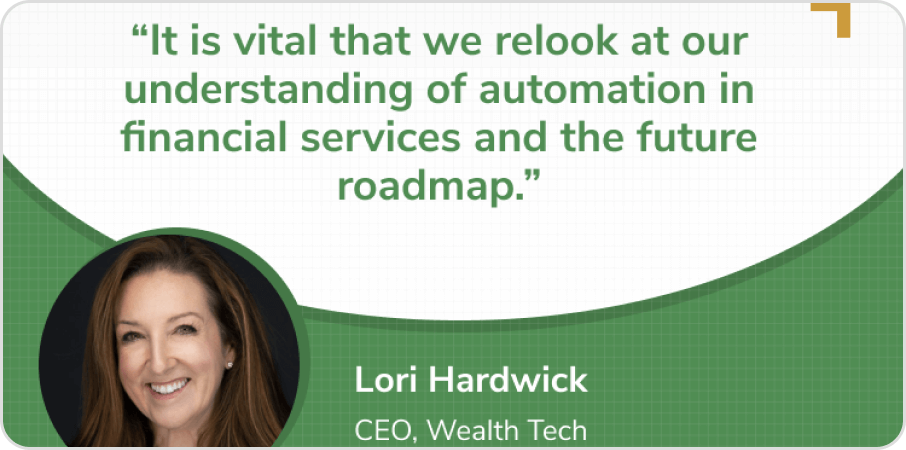
Over the years I’ve been part of several C-suite management teams and corporate boards for leading organizations at the intersection of financial services and tech. One first-hand observation I have made is that automation not only achieves short-term benefits like headcount of expense reduction, but it also creates a ripple effect that permeates across the entire company’s ecosystem. Strategic automation at the backend allows advisors to be more efficient in their work, and in turn, drives a far superior experience for the end customer. To achieve such holistic impacts, it is vital that we relook at our understanding of automation in financial services and the future roadmap.

Financial Services institutions have been primarily focused on building out an integrated infrastructure with interoperability between systems that enable a unified rendering of data for advisors. But this is only step one: It is when effective automation of front, mid, and back-office processes meets 360-degree business objectives, only then, advisors are free to build more capacity in their day and devote their time to more meaningful work, and eventually drive long-term business growth through lasting relationships with customers.

Unlock the potential of AI-powered transformation. Talk to one of our experts today.

Topics: Accounts Payable automationAP automationautomationDigital transformationfinancial serviceRPA