Written by
Payeli Ghosh, Chief People, Marketing and Operations Officer |
Updated on August 4, 2023
There are now increasingly mixed feelings about business process automation, and rightly so. While initially benefits lived up to the early hype (implementations achieve 30% to 200% ROI in the short term, reports McKinsey), mature projects are more disillusioned and typically run into a slew of challenges, particularly scaling. As automation comes of age, traditional approaches like robotic process automation (RPA) or point solutions software for Business Process Management run into roadblocks around scalability, adaptability, and ease of use. The number of companies scaling RPA is growing at snail’s pace, found Deloitte, with just 4% of companies successfully moving into implementations involving 50+ bots1. According to another report by IDG and Appian, automation was only “somewhat effective” (at best) for 65% of business users.2
As your company gears up for a speedy recovery post-COVID-19 – taking advantage of a bullish market – can you afford to be held back by stumbling automation projects?
What is RPA?
Robotic process automation (RPA) uses technology governed by business logic and structured inputs to perform high-volume repetitive tasks in enterprise productivity applications. Using RPA tools, you can configure software, or a “bot” (robot), to process a transaction, manipulate data, trigger responses and communicate with other digital systems. By combining APIs and user interface (UI) interactions, RPA bots can emulate human processes and complete autonomous execution of various business activities.
How to Move Beyond RPA Technology: Is Hyper Automation the Answer?
Over the last few years, RPA has emerged as almost an industry default for automation.
Nearly 1 in 3 companies use RPA technology despite its numerous shortfalls. Robotic process automation is mostly inflexible, with additional configurations needed for any change or extension to the system. You have to put in a lot of development effort, and even when using low-code platforms, there is significant effort duplication.
For example, if the RPA-automated invoice processing in your organization runs into an exception, it has to be manually configured into the script or might even require individual processing into your ERP.
As an enhancement to this, enterprises can choose hyper automation that uses intelligent, cognitive technologies like AI-based process mining, machine learning algorithms, optical character recognition, etc., to make automations more intuitive and efficient. Gartner named hyper automation among the top ten strategic technology trends for last year, anticipating its widespread potential.
But hyper automation is far from reaching maturity. Unless you are a massive organization with a dedicated RPA budget to throw at promising experiments, hyper automation remains out of reach, barring a few one-off projects.
A much more common approach to automating business processes is through SaaS-based point solutions software.
Point solutions introduces a significant degree of automation without most business leaders even realizing it – for instance, a simple scheduling feature on email, automated “nudges” for communication follow-ups, or a copywriting tool automatically checking documents against a style guide. In the wake of COVID-19, point solutions have exploded in popularity as employees/individual business units choose their favorite automation aids without always facing IT intervention.
But, for the organization, this means mounting shadow IT, the risk of fragmentation, and growing dependency on external providers to support dynamic business processes.
What Point Solutions Software Get Right (and What They Do Not)
There is an argument to be made for SaaS-based point solutions software. They are turnkey, easy to use, and – on the surface – involve minimal investments. It was only a matter of time before the “app-ification” of digital activity in the consumer world percolated into business processes, helped by a massive boom in B2B SaaS solutions.
However, the biggest USP of point solutions is their ready-to-use nature, which inherently makes them inflexible. As they target the widest possible user segment (without cognizance of the specific business use case), it is impossible to configure their automation capabilities as per your precise requirements. Or, if deeper configurations are available, you need an in-house expert with knowledge of that point solution.
As your business – and process map – evolves, you will find yourself reaching out to SaaS providers repeatedly to introduce the necessary features. In the long-term, this is an unsustainable model.
How HyperApps Help to Automate Enterprise Business Processes End-to-end
In addition to the three commonly discussed options (RPA, hyper automation, and point solutions), companies can also consider the HyperApp approach when automating business processes. JIFFY.ai’s HyperApps can combine the simplicity of low code with the power of intelligent automation and the cost convenience of SaaS to provide a comprehensive solution that truly empowers your business users.
Here’s a simple example from probably one of the most critical areas of your business, accounts payable processing in enterprise accounting: Let’s suppose as part of a new regulatory requirement, your accounts payable team must report all invoices in a specific currency and upload them into an e-invoicing portal. In the point solution scenario, your team will have to rely on the SaaS vendor to enable this change, who will charge an extra fee for that feature. However, with a HyperApp framework, your invoice processing group can configure that change themselves on the automation platform and make it available not just for the enterprise accounting function, but roll it out across the organization.
Unlike point solutions used for accounts payable automation, you can scale HyperApps to process any volume of invoices (as per our example – it is applicable to virtually any business process) and integrate with new/existing workflows.
Further, HyperApps bring in the flexibility you need in a dynamic business environment. Adapting your enterprise automation solutions to new business process requirements is made simple with a point-and-click interface, while integrations are available natively for use by business stakeholders, with little or no intervention from IT.
This could be a game-changer for companies as they enter a new era of digital transformation through end-to-end enterprise automation post-COVID-19.
Road to Recovery: HyperApps Can be the Pivot for Meaningful Digital Transformation
As companies gear up for what could be the world’s steepest recovery period to date, digitalization could either cripple growth or push it to new heights.
It is estimated that business process automation and an even greater reliance on digital channels will be vital in the emerging future. For example, the number of public sector organizations citing automation as their top 3 priority grew from 23% pre-COVID to 35% in the post-COVID period. HyperApps enable predictable wins in the short term, low effort overheads and greater democratization in the mid-term, and radical advantages in the long term – addressing the challenges of using point solutions for automating business processes.
There’s something to be said for doing the right thing in the right way. The benefits of process automation beyond robotic process automation or point solutions software are undeniable, especially in our new contactless and low-touch world. HyperApps help companies strike the right balance, enabling them to achieve immediate growth targets and paving the way for more opportunities in the future.
Accelerate your automation journey with JIFFY.ai’s low-code platform.
Achieve end-to-end business process automation. Accurately. Easily. Quickly. Email us at marketing@jiffy.ai
Written by
Payeli Ghosh, Chief People, Marketing and Operations Officer |
Updated on August 4, 2023
Great people make great workplaces, and great workplaces make amazing products.
December is typically a reflective time of year for most people and this year is – by far – no exception. Indeed, the pandemic and our response to it gives us further reasons to reflect, offer thanks, and look forward with hope.
As I write this article, we’re also very excited to be finishing off the year on such a positive note because our workplace has been voted as one of the best, most trustworthy workplaces in the Great Place to Work Survey 2020.
Every year, more than 10,000 organizations from over 60 countries partner with Great Place to Work® Institute for assessment, benchmarking and planning actions to strengthen their workplace culture. Great Place to Work® Institute’s methodology is recognized as rigorous and objective and is considered as the gold standard for defining great workplaces across business, academia and government organizations.
Specifically, the metrics around the pride we take in what we do and the camaraderie we share are truly heartening. The free-flowing conversations, the honesty, the friendships we build at work – whether online or in person – these are the things that truly matter to us. While it is often hard to quantify great culture, we’re pleased to report that we’re building a true family here at JIFFY.ai.
From the days of our company’s inception, our leadership team has made building a people-driven culture a key tenet of what drives us. And in the year of the pandemic that forced us to connect remotely and often figure things out over a video call, a culture of putting people first has only gotten stronger.
Being nimble on our virtual toes has been an unprecedented challenge, but when it comes to service, every team member has found it in themselves to rise to the occasion and do what would have once seemed impossible. These attributes are reflected in our high ranking in the Trust Index score, and we couldn’t be happier!
To many more years of changing the world of intelligent automation and remembering to do it with a smile! The JIFFY.ai team wishes you a safe and happy festive season ahead.
Unlock the potential of AI-powered transformation. Talk to one of our experts today.
Written by
Payeli Ghosh, Chief People, Marketing and Operations Officer |
Updated on May 6, 2025
At the office, we’re constantly on the move to meet the deadlines, hit the goal in the bull’s eye and get started with the next task. A couple of minutes by the water cooler, over a sip of coffee at the canteen or a fleeting brush past in the corridors was when we exchanged a quick thank you or appreciated the help.
With team members dotting the globe and working from across countries with newer concepts like WFH and Flexi Locations, work became entirely task oriented. The water cooler isn’t the meet-up spot and the coffee breaks aren’t with teammates.
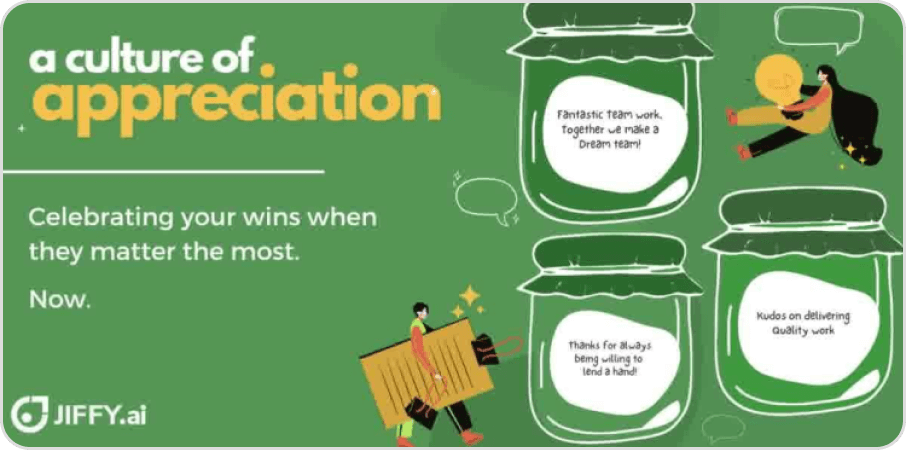
For a holistic work environment, we, at JIFFY.ai figured that we should take a minute out, head over (virtually, at least) to our peers, managers and every teammate to give them a word of appreciation and gratitude. Give them a space to celebrate their wins when they matter the most. NOW.
Here’s what we had to tackle: this is an age of Instagram stories and Snapchat where instant gratification is the trend. But, the sentiment rarely sticks in the flood of content. So we crafted our own framework to facilitate a chain and culture of appreciation for a task well done, smart thinking or even just being patient through the project. After all, people had the right intent and just needed a platform that would help them express themselves.
Welcome to JIFFY.ai’s appreciation program.
From a peer to a manager, everybody in the team shares a dynamic that goes beyond titles and hierarchies. To encourage and celebrate the oneness a team shares, we’ve launched our Appreciation Program that has clicked so well with our JIFFYians.
We take a moment to write a note and share gratitude and appreciation with a fellow teammate. Acknowledge their effort, let them know they’re seen and keep the cycle of wholesome validation going.
The Joy of being a JIFFYian lies in relishing the small things and it is truly heartwarming to see managers and peers come together to appreciate each other. The most important thing in the program is intent, the titles and ranks don’t come into play.
An appreciation program works so beautifully only when our fellow JIFFYians take part in the cause with wholehearted enthusiasm so here’s a big thank you everyone at team JIFFY.ai. You made this work. Kudos to you!
Unlock the potential of AI-powered transformation. Talk to one of our experts today.
Written by
Payeli Ghosh, Chief People, Marketing and Operations Officer |
Updated on May 6, 2025
Fitness is not about getting into a particular shape or looking in a certain way, it is an internal process of evolving bodies and turning smarter, kinder, and more accepting of life with its ups and downs.
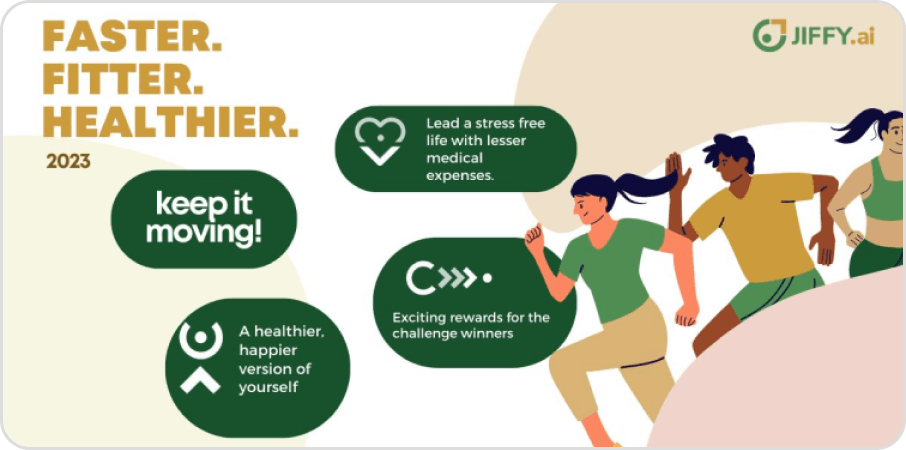
A healthy workplace leads to high employee morale and productivity. Well-being impacts employee and organizational performance. It is the responsibility of every organization to provide a healthy and safe workplace for its employees. JIFFY.ai we are committed to the holistic development of our people and, keeping this in mind, we have launched a fitness campaign “Faster Fitter & Healthier (FFH) 2023”. There are a series of monthly activities planned as part of this program. We started with the “Step It Up” challenge. This blog aims to reflect on the experience, express appreciation, and acknowledge our organization for promoting fitness and well-being.
The Challenge: The “Step It Up” challenge urged us to take 6,000 steps daily, and encouraged us to prioritize physical activity and incorporate it into our daily routines. It was a simple yet impactful challenge that pushed us to be more mindful of our movement and make conscious efforts to enhance our overall fitness.
Well-Being Champion:Sekhar Prakash, Head of Cloud Engineering was appointed as an internal well-being champion to lead the program and build a wellness culture within the Organization. My heartfelt gratitude to Sekhar for taking up this challenge.
Overwhelming participation: I am truly amazed by the level of participation we witnessed throughout the challenge. From seasoned fitness enthusiasts to individuals just starting their fitness journey, our colleagues came together with a shared commitment to prioritize their health. It was heartening to witness the camaraderie and support that developed within the organization as we motivated each other to achieve our daily goals.
Building Healthy Habits: Habits go a long way. The “Step It Up” challenge not only encouraged us to be more physically active but also helped us cultivate healthy habits. We discovered innovative ways to incorporate more steps into our daily lives, such as taking the stairs instead of the elevators, going for brisk walks during breaks, and even organizing walking meetings. These small changes had a significant impact on our overall well-being, boosting our energy levels and improving our productivity.
Dear #JIFFYians, let’s continue this momentum as we move forward with the “Faster, Fitter, Healthier 2023” campaign, supporting each other in our pursuit of better health and well-being. Remember, the journey has just begun, and together, we can achieve remarkable things! Keep stepping up, stay healthy, and let’s thrive together!
Unlock the potential of AI-powered transformation. Talk to one of our experts today.
Written by
Payeli Ghosh, Chief People, Marketing and Operations Officer |
Updated on May 7, 2025
Companies that recognize their employees as their greatest asset and invest in people first go longer distances. Human Resources in many companies has become a key strategic partner to the C-suite, helping to spearhead digital transformation across the organization to not only drive value but also to support the attraction, retention, and engagement of a happy workforce. Focused transformation within the HR practice itself can also drive efficiency and improve employee attraction and retention. More HR leaders than ever before are looking at themselves and their teams as a critical starting point for employee experience excellence, digital transformation and innovation within the business.
Cases in point (and there are many) are Google and Microsoft, which are both highly people-oriented in terms of the opportunities they provide to their employees and how seriously they value engagement as a metric.
Technology has helped the HR function immensely, both to achieve efficiency and to make processes smoother. Particularly for growing organizations, HR technology can ensure all stakeholders, as well as potential new talent, receive a consistent, excellent experience.
Creating Capacity For The Real People Work
HR leaders today have a tough job, indeed. Massive job losses and pay cuts are being reported across the board and managing the people function is twice as challenging as ever. In the post COVID-19 reality, employee experience is going to be extremely important, and significant. Not only is it important to protect and engage internal stakeholders, potential talent will closely watch to see how a company’s people are treated before making a decision.
The strategic and thoughtful use of technology and tools can free up time for professionals to focus on tasks that need true hands-on attention. One of the key points of resistance to technology adoption is that it might replace the need for people. Yet, the reality is that technology helps take over routine, repetitive, cumbersome tasks and allows people to focus on areas that need a more well-rounded approach to problem-solving.
The same goes for using technology in HR.
What was once an unending stack of paperwork or an unending stream of digital documents to move along through a process can now be automated. Some of the areas with the highest need for automation in HR include employee onboarding, data management, employee offboarding, payroll management, and talent acquisition.
For one of our clients, Jiffy.ai has been able to manage the regular churn and process over 600 contractors per cycle in a fully automated manner. The entire employee onboarding and offboarding process can be automated using intelligent automation, too, ensuring at each step that the process is not only seamless but also human. In the context of employee data management, automation can help accomplish what would ordinarily take at least two people working for 1 hour per employee. For a luxury real estate firm, Jiffy.ai has created tremendous value by automating processes for a 400% reduction in manual effort.
This is time best spent in quality people interactions. The New Now will see a rise in the need for managing not just the work people are doing but having a greater pulse on their wellness and emotional state. HR managers will be called upon to bring teams together by showing each individual the path to their growth and the synergies with the big picture of the organization. All this will need human time and energy.
HR And Automation In The Context Of Remote Work
If there’s one thing the pandemic has done for the New Now, it is to accelerate the process of technology adoption. While employees now work from locations as diverse as the size of the team itself, management teams have had to adjust to a completely new way of reconciling performance and rewards and getting their bearings on what is actually going on.
Indeed, many companies are reeling under the pressure of circumstances that change every week, maybe sooner, and the C-suite is reacting as strategically and as swiftly as possible to keep their businesses open.
In this context, delegating not just performance management but also the entire onboarding process to a technology tool is one great way to free up time and the much-needed headspace to work on complex decision-making and have meaningful interactions. Jiffy.ai has successfully implemented automation in HR for a leading global audit and consulting firm. Here’s what we have been able to do for them:
Moving contractor interactions to a web interface
Making communication smoother and more efficient with Exchange mailboxes
Automating the onboarding process entirely
As a result, the firm has been able to achieve these significant outcomes:
An increase in the onboarding capacity to 100 contractors per month
A sharp decrease in onboarding time from 3 hours (manually) to 17 minutes (when using RPA)
16 of the 20 core onboarding processes are now fully automated
An onboarding process that runs 24X7 without the need for, or with minimal, manual intervention
Here’s a simple example of what a manual HR process would look like when automated, and the savings on time that can be expected as a result.
The role of HR has never been more critical than it is now. New tools and applications can aid HR leaders immensely in making this shift for their organizations. By relegating processes to automation and shifting its focus to its people, HR has an opportunity to help their entire enterprise not just to survive change but to be able to thrive in it.
Unlock the potential of AI-powered transformation. Talk to one of our experts today.