Written by
Penny Phillips, President and Co-Founder of Journey Strategic Wealth |
Updated on June 18, 2025
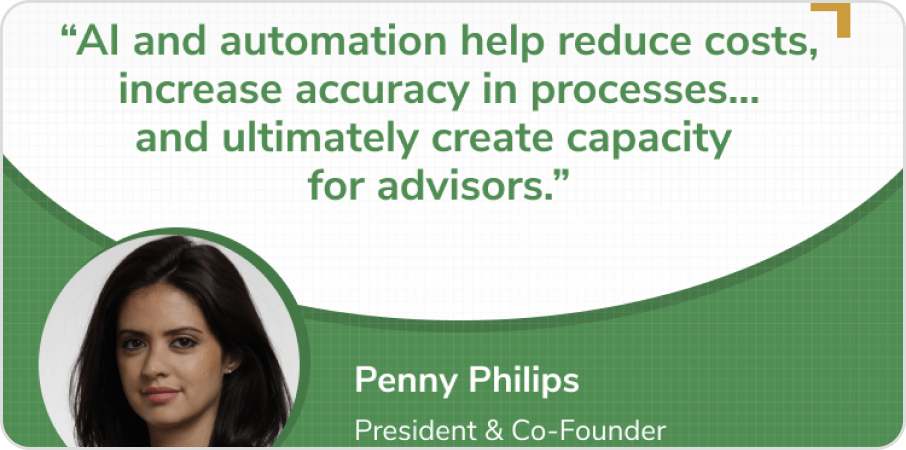
We cannot emphasize enough the impact that artificial intelligence (AI) and automation (specifically Robotic Process Automation) has had, and will continue to have, on our industry. In fact, most advisors have grown so accustomed to their benefits, that they may not even realize the daily impact to their practices and clients. Consider your custodial platform and the way a client’s information seamlessly prepopulates in the system if he/she/they already has an account there. Or think about quarterly performance reporting; with the push a few buttons, you can generate reports for every single household in just a few minutes. AI and automation help reduce costs, increase accuracy in processes (like account opening) and ultimately create capacity for advisors, conceivably leading to increased revenue and profits.
There are challenges, however, that individual advisors face as it relates to embracing this new age of technology and fully automating their operations. First of all, some advisors are not yet reaping the full benefits; advisors within larger institutions are oftentimes limited to the systems and tools available at their home firm, many of which are siloed, fragmented, and outdated.
Advisors who CAN build their own tech stack often struggle with “technology overload” and feel paralyzed by the many options and customizations. In addition, training staff can be challenging. Even with access to the best operational tools, many advisory teams still use excel spreadsheets to manage and analyze data about their practices. Finally, redeploying human capital towards revenue-generating activities is no easy feat. Work expands to fill the time we have to complete it, so ironically, just because capacity has been created, does not necessarily mean the time will be filled with productive work.
Unlock the potential of AI-powered transformation. Talk to one of our experts today.
With COVID-19 causing risks to human health and disruption to our way of life in general, especially the way we work, companies have been forced to pursue alternate ways of making progress. Many of them are striving to use intelligent automation and AI to innovate their way forward while working safely from home.
This shift does not mean that we do not value human work, or the role people play in the enterprise. Think about the agricultural revolution. In the 18th century, people transitioned from hard laboring stationary farming to original inventions that altered the farming process. The new patterns of crop rotation and livestock utilization paved the way for better crop yields and the ability to support more animals. It was an opportunity to produce more, not a judgment of the reduced value of human work.
These agricultural changes impacted societies as there was a decline in both the intensity of the work and the number of farming laborers needed. Nevertheless, the positive effects of this disruption gave life to new technologies and opportunities as people migrated to the city to work in industrial jobs. As humans, it’s in our nature to innovate and create new solutions that become paramount to organizations and the people that work within them. We believe that as intelligent automation, Artificial Intelligence, and Machine Learning continue to evolve, we have an opportunity to harness this energy of innovation in a whole new way.
Our mission is to enable organizations to cross the human machine divide that has existed since the introduction of machines and enable them to co-exist seamlessly. We aim to reduce the friction between the two in a natural, human-friendly way. Eliminating the need for expensive translation mechanisms in the form of data entry, data synchronization and mundane activities allows organizations to become extremely efficient and resilient. Enabling innovation within the enterprise using natural language instructions, we bring out the innovator in the everyday business user. By letting the machines understand human language to achieve automation we drive speed in business transformation previously not possible. This is the core of our perspective on automation.
For too long, enterprises have placed contradictory expectations on their most talented thought leaders and employees. We have expected people to be innovative while also weighing them down with administrative tasks. Research shows “task switching” disrupts flow of thought and creativity. Ultimately, we launched JIFFY.ai to reduce this phenomenon and to allow creativity to flourish and innovation to be unleashed in its most uninterrupted form. Our relentless commitment is to see a change in how organizations redesign their work, supporting them through the power that automation and AI offers to maximize strength, resiliency and scale.
Historically, automation was seen as a point solution for mundane actions. You gave it a specific function or set of functions, and it performed. Now, technology allows us to elevate and redefine the process and achieve progress through automation. This change is necessary in the ever-evolving landscape in which we live.
Unlock the potential of AI-powered transformation. Talk to one of our experts today.
As we wrap up the first half of 2021, several parts of the world are still reeling under the impact of the successive waves of the pandemic. Maintaining business continuity and building resilience for predictable growth is an imperative for businesses across the world. With industries gearing up for bullish economic weather, business leaders are leaving no stone unturned to remove all process bottlenecks that could pose hurdles in their resurgence strategies. Your Accounts Payable team plays a central role here, maintaining transactional integrity, ensuring sustainable cash flow, and powering your core business, often with limited and restricted resources.
Process modernization and optimization are key priorities for Accounts Payable teams that have already embarked on this transformational journey. According to the Impact of the COVID-19 Pandemic survey by the Association for Financial Professionals (AFP), 65% of businesses will move from paper payments to electronic formats, while 38% will rewire their internal procedures. Digitization will pave the way for smarter, more efficient processes, where employees need to spend far fewer person-hours to complete routine tasks, thus unlocking savings as well as ushering in an overall culture shift.
If your Accounts Payable team is already on this superfast transformation highway, here are five key takeaways for you:
1. Consolidate the digital forays of the previous year
The first step towards building a futuristic invoice processing strategy should be consolidating the fragmented digital transformation initiatives undertaken last year. In 2020, businesses had to adopt remote-friendly processes and support Accounts Payable teams as they started to work from home almost overnight. In some cases, this added to process complexity as simple in-person tasks (e.g., paper-based approvals) were no longer possible. Supplier/vendor network management also went digital, which has its own risks in the long term. At this point, it is vital to consolidate any point solutions you might have in place, take stock of vendor sentiment and any user experience bottlenecks they might be facing, and evaluate the projected total cost of ownership of your Accounts Payable systems beyond the pandemic.
2. Optimize cash flow to prepare for unexpected challenges
The pandemic left very little room for error in cash flow management, and this trend will continue in the second half of 2021 as economies recover and businesses return to their growth trajectory. A report by the International Labor Organization found that cash flow was the #1 problem faced by 4500+ companies in 45 countries worldwide. Improving Accounts Payable efficiency and modernizing your invoice processing strategy could help optimize cash flow. For instance, recommendations generated by cognitive technologies could suggest changes in the order of supplier payments that would maximize your cash on hand. These technologies can assign risk scores to every vendor and make sure that you gain from early payment discounts.
3. Upskill your AP team to perform and innovate
The year 2020 marked a tectonic shift in how we work, and this will have a lasting impact on workplace culture, how employees approach routine tasks, and their aspirations for the future. In the absence of a physical office and the physical presence of a professional community, inefficiencies in business processes became starker. Your employees are now less likely to be satisfied with repetitive, high-volume tasks in this ‘work from home’ season. There are two major action points for businesses through the year 2021. Eliminate mundane, iterative and non-fulfilling work wherever possible (this has typically been a chronic challenge for the Accounts Payable team). Employees who are freed up can be up-skilled to focus on more innovative work, such as in decision-making, the use of advanced technology systems, and discretionary problem-solving: essentially, tasks that machines cannot perform.
4. Adopt agile workflows to gain from dynamic economic weather
Through the rest of this year, businesses can look forward to a largely optimistic economic forecast, albeit with occasional regional curveballs on the way. In the last couple of quarters, we saw the International Monetary Fund revise its predictions several times, underscoring the need to stay agile and adaptive. In this context, rigid Accounts Payable workflows and monolithic processes will make it difficult to keep pace with fluctuating conditions. Instead, businesses must establish processes that are easy to configure – onboarding new suppliers with minimal risk or delays to support renewed demand, reconciling invoice exceptions and corrections seamlessly, and scaling up without adding complex approval red tape.
5. Leverage intelligent invoice processing automation to scale sustainably as you grow
The best-case scenario to look forward to this year is a rapid return to the original growth trajectories, aided by a resurging economy in 2021-2022. Businesses cannot afford to let speed-breakers such as inefficient processes, errors arising from human fatigue, and the risk of non-compliance, slow down this journey. The Accounts Payable function as a whole — and invoice processing, specifically — is part of the core of any organization. As the throughput of your Accounts Payable team increases, its invoice processing capability must focus on increasing straight through processing capacity. That way, it can scale in tandem to make profitability truly sustainable and mitigate the impacts of any further unprecedented disruptions. Strengthening this function using cutting-edge technology, helping your AP team and the supplier network, and the business as a whole should be a key agenda item in your strategy.
Your top strategic priority for the emerging future should be to remove the bottlenecks in the invoice processing function, and intelligent automation can play a key role here. Here are a few points to ponder:
An intelligent automation solution can centralize the steps taken to digitize invoice processing in specific business units, regions, and teams amid the rushed switch to remote operations.
It can equip your AP function with customizable supplier portals, AI/ML insights, and suggestions for decision-making based on your business rules, thus optimizing cash flow.
It can ingest invoicing data from EDI file formats, XML/JSON files, mailbox attachments, and scanned images, making life simpler for your AP team working remotely; automated data extraction, validation, and exception handling further reduces repetitive manual work and probable errors.
An end-to-end intelligent automation platform makes touchless processing a reality by supporting highly configurable workflows, where you can specify thresholds for manual approval, fraud signals, vendor prioritization and more, depending on changing market conditions.
Invoice processing costs can be optimized as your business operations scale (thanks to a scalable solution architecture and volume-friendly pricing model), making the investment in digitalizing your Accounts Payable function truly sustainable for the long term.
Learn how JIFFY.ai’s intelligent Invoice Processing HyperApp has been enabling customers from various industries to prioritize these five capabilities. In fact, these are a part of our central value proposition to future-proof the Accounts Payable function. Drop an email to marketing@jiffy.ai today.
Unlock the potential of AI-powered transformation. Talk to one of our experts today.
Even with all your enterprise-level digital adoption, accounts payable can still be one of the most paper-intensive departments in your organization. The team’s primary function, invoice processing, costs the company resources due to time-consuming and repetitive tasks, slow processing cycles and human-introduced errors. The longer you ignore the cost of manually processing invoices, the deeper the dents it tends to cause in your organization’s bottom line. Learn how the benefits of accounts payable automation can reverse that trend.
The True Cost of Your Invoice Processing Flow
The U.S. Institute of Finance & Management (IOFM) suggests that the cost of processing a single invoice can be anywhere between $1 and $21. Putting this into perspective, think of a mid-sized company that has approximately 1,000 invoices to process per month. They would lose significant money through the gaps caused by process inefficiency. AP automation benefits can help to solve those inefficiencies and reduce your invoice processing costs.
What Makes Invoice Processing Expensive?
Wondering how best to calculate the expense of processing invoices in your organization? The simplest way is to equate it with the costs of associated human effort. Typically, a member of your accounts payable team would take at least 30 minutes to process a single invoice. Considering the average salary of an accounts payable clerk in the U.S. is $43,917 (approximately $21 per hour), processing one invoice could cost $10.50. For the mid-sized company mentioned earlier, this would add up to more than $10,000 every month.
And that’s not all! At this point, we’ve only discussed the base costs involved. But there’s more to it, such as:
Cost of fixing manual errors: Invoice processing is highly susceptible to errors due to daily variances, volume-based pressure or sometimes even sheer human fatigue. To fix such errors on a paper invoice, you might have to spend a significant $53.50 to create a new document, communicate with different stakeholders and redact payments already made.
Lost opportunity costs, such as discounts: Most vendors offer discounts for early payments, which can be as much as 2% to 5%. Manual invoice processing can create delays, causing the payment to miss the discount window.
Strained vendor relationships: The inefficiencies related to manual invoice processing, such as delayed payments, payment redactions and multiple requests for the same information, can seriously damage your brand’s reputation in today’s vendor and supplier landscape. More severe mistakes could even harm long-term relationships, adding to your overall invoice processing costs.
Physical costs, like storage and paper: Manual invoice processing goes together with paper-based processes, involving costs for physical file storage, stationery, etc. Unstructured hybrid systems can be even more expensive as the accounts payable team might have to switch between digital and paper formats, spawning duplication.
Cost of efforts diverted from core functions: Finally, complex approval processes coupled with frequent exceptions call for measures by personnel outside the invoice processing team. Business leaders might have to intervene in invoice processing, and their valuable person-hours (which would otherwise be spent on higher-value functions) must be factored in.
What is Invoice Workflow Automation & STP?
Invoice automation and the benefits of accounts payable automation go beyond barebones e-invoicing, which only recreates paper processes in a digital format and replicates its inefficiencies. The intelligent automation of invoice processing leverages technology in a meaningful way to remove the bottlenecks in your accounts payable workflow, bringing human intervention down to near-zero. This enables straight-through processing, or STP, where automated technology manages the end-to-end invoice lifecycle, and the average handling time by humans is dramatically reduced.
6 AP Automation Benefits That Achieve STP and Help Reduce Invoice Processing Costs
1. Extract Invoice Data Using Artificial Intelligence and Machine Learning
AI/ML-based technology such as object recognition and optical character recognition (OCR) can extract data from scanned images, PDF snapshots, etc. and automatically populate the fields in your accounts payable system. Intelligent invoice extraction is compatible with country-specific EDI formats, XML/JSON files, scanned images and even mailbox attachments.
2. Set up A Custom Supplier Portal
The worst long-term issue caused by inefficient invoice processing is probably the erosion of trust in vendor relationships. The smart UX of an automated solution allows you to set up a digital portal where vendors and suppliers can choose their relevant forms, make data entries and enjoy seamless interactions with your invoice processing team.
3. Configure Workflows to Handle Exceptions
Among the many benefits of accounts payable automation, automated exception handling lets your accounts payable staff tackle complex invoice scenarios without claiming the time of multiple business stakeholders. For example, they can set up workflows to handle exceptions such as potential signs of fraud, invalid vendor data, invalid file formats and specific PO detail mismatches. Configurable rules like these for invoice validation reduce an agent’s time to manually process an invoice by 80%.
4.Integrate with Your ERP
An AP automation workflow can connect with your existing systems like SAP, Oracle, Pegasus, Microsoft Dynamics, Salesforce, Infor, Sage or homegrown applications to enable bi-directional data flow. Your ERP can act as the reference for validating extracted invoice data (which otherwise needs to be performed by an AP staff member) and document the workflow information.
5. Gain from Analytics and Data Insights
Over and above AP automation benefits like lower invoice processing costs, automation becomes a true value generator here. First, it uses validation rules to assign a risk assessment score to every invoice. It also prioritizes tasks automatically based on load, productivity or your unique segmentation rules. Next, it uncovers vital data from your invoice processes to highlight productivity trends, KPIs and improvement areas, creating real-time visibility into invoices pending approval.
6. Consider Hosting on the Cloud
Cloud-based workflow automation software significantly lowers your upfront costs and ongoing maintenance overhead, while reducing your overall TCO. On-premises partly managed hosting is also an option in areas where there are critical regulatory requirements.
Save More as You Grow. Make Accounts Payable a Profit Center.
While traditional invoice processing methods become more expensive with scale (as volume and costs are directly related), intelligent automation and STP allow you to reduce costs as you grow. As the solution architecture is inherently scalable, your automation partner can offer volume-based efficiencies — for example, incrementally reduced pricing for volume tiers above 5,000 invoices per month.
JIFFY.ai delivers invoice processing and accounts payable automation benefits for small businesses, large finance and accounting teams and every organization in between. We can help them achieve 80% STP and reduce the human efforts needed to process invoices from a new supplier to 0%. Sophisticated AI and ML-based workflows allow you to look beyond just replicating age-old manual processes in a digital wireframe. Leveraging our intelligent and scalable automation HyperApps, we are committed to helping future-oriented enterprises derive business value across critical functions like accounts payable.
Get the Benefits of Accounts Payable Automation with JIFFY.ai
If you want to iron out bottlenecks or inefficiencies in your business processes through sustainable, intelligent invoice processing automation, please email us at marketing@jiffy.ai. Our HyperApps experts will be happy to help you accelerate!
Unlock the potential of AI-powered transformation. Talk to one of our experts today.
2020 was a landmark year for digital transformation. In the face of an unprecedented global crisis, technology emerged as the key enabler for resilience for all types of businesses —small teams or multinational enterprises, consumer-oriented or B2B vendors alike. Now, as we work through the road to recovery, many face the slightly uncomfortable question: How much of this change is scalable and operationally sustainable for the long term, including in terms of ROI?
The question becomes more pertinent as we look at these facts from McKinsey & Company’s recent report on the sheer pace of digital transformation last year:
The digitalization of customer interactions accelerated by 3 years globally.
Companies started to digitally reimagine their products/services 7 years ahead of schedule.
Over 6 in 10 executives believe customer expectations have changed forever.
Yet, most companies are not positioned to sustain their digital transformation projects for the long haul. Only half of them believe that the rapid surge in adoption of technology for their operations will continue after the pandemic – which could potentially stall progress or set the other half back by several years and tens of thousands of dollars of hurried sunk costs. Of course, there is always this risk when the shift is due to a black-swan moment and not organic, evolutionary change.
Moving beyond the pandemic, organizations will have to take hard-won learnings about the need for flexibility and responsiveness of AI digital transformation initiatives and determine ways to build real and lasting resilience that can ensure growth and the capability to weather future storms. A prime example of this is the accelerating trend of using intelligent automation digital transformation roadmaps, and automating more complex end-to-end business processes in a scalable, more sustainable way.
How the Pandemic Revealed Crucial Gaps in Digital Transformation plans
Many businesses learned vital lessons through the last year — involving crucial gaps that otherwise would have gone unnoticed — when they tried to push the pedal to the metal on their digital transformation plans.
Technology sprawl: In a bid to speed up digital adoption, business units and individual users were ready to adopt their favorite applications and enablers ‘under the radar’. This contributed to the ever-sprawling shadow IT landscape without organizational visibility, coordination or leverage. Only an integrated enterprise automation solution can put the power of technology enablement back in the hands of business users while keeping it within the realm of the organization’s overarching digital transformation framework and technology strategy.
Higher propensity for technical debt: If shadow IT was one side of the coin, the other was retro-fitted automation often requiring many code changes that aren’t always reconciled. In the pre-pandemic world, organizations were already struggling with technical debt as a multitude of non-integrated automation technologies were applied to legacy systems. In the emerging normal, they will look for ways to implement technology capabilities faster, without dramatic overhauls and inflexibility that results in technical debt. Adopting a HyperApps approach is a more viable way to achieve scalable, sustainable automation.
Culture woes: Cultural dissonance blocks digital transformation like no other variable. If business users, leaders, and decision makers aren’t on the same page, both strategically and in terms of execution, the dissonance will bring digital transformation to a standstill sooner than later. To prevent this, technology enablers must intersect larger strategic goals with short-term business outcomes and democratized use, and adopt platforms that enable this.
The first step to overcoming these challenges is to place sustainable automation at the core — of course, leaning into the best practical way of doing it — and to leverage the convergence of all its powerful capabilities. These include AI, Machine Learning, cognitive capabilities, cloud computing, no-code/low-code application development, and end-to-end integration, combined with a human-in-the-loop approach, where enterprises can achieve maximum advantages.
Can Digital Transformation Happen Without Automation?
Automation in many forms, including robotic process automation (RPA), has quickly become one of the integral pillars for digital transformation. An RPA digital transformation brings about incremental improvements in process efficiency, and step-level improvements in enterprise capability when applied strategically. It builds resilience to crises, like a pandemic or economic slowdown, where labor shortage and market volatility would disrupt traditional production systems. Automation also makes room and provides for further innovation by freeing up budgets and resources and ensuring that digital transformation works in an ongoing, iterative cycle. Digital transformation without automation is like a car with a limited engine: it simply cannot go the distance with the power to transform and accelerate, and can consume more effort to maintain than the value it generates.
So, it shouldn’t come as a surprise that 81% of IT organizations will automate more tasks to allow team members to focus on innovation over the next 12 months to 18 months, which according to Salesforce, will drive true digital transformation.
What should come as a surprise is that problems such as integration, script maintenance, control, compliance and scalability continue to plague traditional RPA deployments. This is a worrying fact, given that 84% of decision-makers plan to increase their investments in automation – without the assurance of sustained ROI or an uncomplicated implementation roadmap.
While traditional RPA relies on rule-based engines and technical configurations to automate workflows at the task level, HyperApps take a more democratized, business user-oriented approach for achieving end-to-end business process automation, and optimizing machine-human collaboration. They have a GUI platform where business users, data scientists, and IT professionals – stakeholders across the digital spectrum – can participate in setting up and operating meaningful business process automation.
This approach enables teams across the organization to implement, iterate, scale and grow, and addresses many of the challenges organizations currently face when preparing transformation projects for long-term sustainability. It also facilitates optimum teamwork and a culture of innovation.
HyperApps can automate business processes across the board, shrinking the technology sprawl.
The no-code interface empowers teams, reduces maintenance needs and technical debt.
HyperApp components are reusable and scalable, which lowers total cost of ownership (TCO), and accelerates time to value and ROI.
Compliance is baked-in, without requiring further investment.
Ultimately, automation will be central to long-term digital transformation as organizations look beyond short-term responses and adopt SaaS strategically to address new omnichannel opportunities. By opting for HyperApps, they can address the foundational challenges of their RPA investments and take enterprise automation to the next level.
Making Digital Transformation Scalable, Sustainable and Future-oriented
The pandemic brought about a rapid global paradigm shift, wherein businesses focused more than ever on delivering against digital-first customer expectations. It heralded a new normal of empowered employees who seek more autonomy, and of organizational resilience without taking success/market leadership for granted. For this emerging future, your investments in digital transformation shouldn’t be only considered as ‘crisis response’, but must hold their own and continue to evolve with the same urgency going forward, generating value beyond the pandemic.
Contact Us Today to Learn More About Intelligent Automation Digital Transformation
If you are looking to iron out bottlenecks or inefficiencies in your business processes through sustainable, intelligent automation, please contact us and our HyperApps experts will be happy to help you accelerate!
Implementing and managing an intelligent automation platform, which includes Machine Learning and Robotic Process Automation (RPA) powered by Artificial Intelligence (AI), can be a complex endeavor, depending on where an organization is in their automation journey. Customers prefer vendors that offer strong service and support enabled by help desk AI technology, especially early in the process. It can make a big difference in the outcomes of a complete, end-to-end business process automation project. Here, JIFFY.ai AUTOMATE users on IT Central Station discuss the importance of support, as well as their use cases and the benefits they’ve seen with the technology.
Process automation use cases
IT Central Station members are finding a variety of uses for JIFFY.ai AUTOMATE in process automation. For example, John G., a VP Engineering at a computer software company, uses the tool in production for driving a Windows application. It extracts content from the Windows app, using JIFFY.ai’s OCR features in the process, and submits images into the application. The actual images are being extracted and returned to them as a document.
For Johnson M., a National Professional Officer at an international affairs institute with more than 5,000 employees, JIFFY.ai AUTOMATE is primarily used for processing documents in procurement and payroll. In one case, the tool creates an attestation letter for Human Resources (HR) for people who are leaving the organization. An IT Manager at a smaller tech services company has two use cases: Bank conflation and a Wage Protection System (WPS), which is a way to calculate and manage salaries per person.
Benefits of process automation
“The system in production completely eliminated the need for human intervention,” explained John G. “From time to time, we need to check the user interface and results, but that is very rare. It can be done once a week, or even less frequently.” A Managing Director, Business Transformation at an airline with over 10,000 employees similarly noted, “We’ve seen really good productivity gains. For the areas where we’ve chosen to automate, it’s not that we have freed up 30 heads in one area with one project. It’s more an aggregation of 20 heads across all of the different bots that have been developed. But we’ve seen tremendous value, especially in the pandemic.”
This user provided additional context, sharing, “As an airline, we have had to cut costs and we were able to go through some pretty strong voluntary separation efforts and redistribute resources and cover things because of the automation work that we’ve been doing.” For the tech services IT Manager, “[JIFFY.ai AUTOMATE] makes the developer’s work easy. With the customization option, we can write custom expressions using its compatibility with Python or other programming languages. Their web automation is good.”
Johnson M acknowledged the tool’s accuracy. He said, “For staff, it is common when doing repetitive work that there tend to be mistakes. There will be a missing digit or letter here and there, but JIFFY.ai AUTOMATE never does that. It is accurate to a ‘t’. It encompasses errors only if the input is poorly done, so it does not commit errors when it does this process. JIFFY.ai AUTOMATE has reduced manual processing for the 25 percent of the processes that it has automated.”
How great service fits into the user experience
Process automation can get complicated, so it’s useful to be able to draw on healthy vendor support. The airline’s Managing Director provided an example, saying, “Our cybersecurity positioning and stance on what we expect and what we allow and don’t allow, are pretty advanced. It was a pretty tall order to meet a lot of our cybersecurity constraints, so that’s an area where we had to do quite a bit of work. The very first bot we put into production fell into the PCI realm. We actually have two environments, one that has to be PCI-compliant, and a regular environment, and JIFFY.ai has been fantastic from a partnership perspective.”
They further noted, “A lot of the challenges that we uncover are really internal to our environment, as opposed to the platform. There’s a little bit of both, and that’s where it really comes back to the partnership with JIFFY.ai. They are always super-responsive in addressing any challenges with the product or the platform and supporting us as we work through how to integrate or automate a certain homegrown application of ours that is probably an outdated legacy application.”
“They have good support,” observed the tech services IT Manager. “There is a team who is ready to build whatever we ask. That is why we are still using this solution. When we are stuck on issues, there should be a team to back us up. We needed somebody like JIFFY.ai because we found we could go into the code level and make changes. Their team was there for support. They never complained whenever we threw non-standard practices at them; they never tried to correct us.”
To learn more about what IT Central Station members think about process automation and JIFFY.ai AUTOMATE, visit JIFFY.ai on IT Central Station.
Unlock the potential of AI-powered transformation. Talk to one of our experts today.
How to build efficiency using intelligent automation and cognitive procurement
When we think of robotic process automation (RPA) in procurement, we know that adoption is rising. Many businesses already use RPA in their value chain. For those businesses that aren’t, it is a matter of “when” and not “if” they will use RPA.
In a domain as complex as procurement, robotic process automation ensures that most tasks and processes are automated at a fraction of the cost of adding headcount/resources or deploying new teams. Another benefit of procurement automation is the ability to work around the clock, which significantly reduces dependence on human resources.
The true value of RPA is the ability to repeat complex tasks and follow decision trees effectively. As machine learning, cognitive processing and natural language processing gain traction and advance at an accelerated pace, it is only natural to integrate these systems with RPA to deliver a more effective solution across the value chain.
Let’s dive deeper into why machine learning, cognitive processing, natural language processing, analytics and RPA must go hand-in-hand. We’ll also discuss how learning algorithms coupled with RPA’s execution capabilities are the future of full automation — especially after the pandemic.
What is Cognitive Procurement?
In the field of supply chain automation, cognitive procurement refers to the process of using automation with machine learning, analytics, and other cutting-edge technologies to help automate further, faster, and more efficiently.
Procurement as a process is characterized by large amounts of unstructured data, which may be impossible to process using traditional systems. Apart from solving the problem of unstructured data handling, cognitive procurement also helps:
Transform all existing purchase and transfer order systems
Transform supplier onboarding and the associated processes
Forecast prices and inventory needs
Create reports with usable data
Power better decision-making
Conduct risk assessment to prepare for known threats to the value chain
The best part? A cognitive procurement solution can also connect to external data sources and tie these parameters into the recommendations it makes. RPA alone may not be enough, but when it’s supported with the right data and learning systems the procurement possibilities are nearly endless.
Intelligent RPA and its Role in Cognitive Procurement
Cognitive procurement is often referred to as the final frontier in the procurement process. However, wisdom and experience show that there is still much to learn. In the era of information, we need a system that can handle three aspects of any complex task:
Research and data processing: This is where analytics come into the picture.
Learning from past data to make accurate predictions for the future: Machine learning works on the principle that when an artificially intelligent system is given enough data, it can make decisions as good as or better than those made by a person.
Execution: Any plan is only as good as its implementation, the sheer volume of work and the number of branches in the process. Post-machine learning interventions need RPA to help in seamless execution.
As a final product of automated procurement, businesses with a vast and demanding procurement function can expect to:
Achieve efficiency in analyzing their data
Manage their supply risk
Procure and pause material based on real-time needs
Plan logistics for better efficiency and optimized costs
Evaluate their suppliers based on their monthly, quarterly or annual performance across as many parameters as needed
Provide 24/7 support throughout
Why Should You Implement an Intelligent RPA Solution in Procurement?
According to a KPMG research report, “Delivering Value in Procurement With Robotic Process Automation,” implementing intelligent RPA can cut procurement costs more than 50%, increase return on investment (ROI) by five times and reduce the number of strategic suppliers by nearly 50%. These numbers should eliminate the concern over RPA’s cost-to-benefit ratio, which is a frequent barrier to implementation.
How Should Businesses Decide Where and How to Implement RPA in Their Procurement Process?
Start by reviewing existing procurement processes to identify areas where the scope for automation is high. These tasks often represent repetitive actions that offer less value per extra time unit spent.
However, for an RPA system to work, the process needs to have a clear workflow and lead to non-ambiguous outcomes. Technical specifications include processes that run in relatively stable environments and cases where manual intervention to solve an impasse can be kept low.
Next, identify the processes based on how much business impact automation could create and how much effort might be necessary to implement RPA. With these conditions in mind, classify the tasks into low-impact, low-effort-to-implement processes, which make for good early adoption and trial cases, and high-impact, high-effort-to-implement processes, which can effectively transform the business.
As a process laden with numbers and data, procurement presents the best-use case for implementing RPA in tandem with data analytics and machine learning. Companies that have already done so report unprecedented results across crucial parameters.
A fear of “machines taking over the world” is one barrier to implementing robotic process automation in procurement. But machine control in cases as complex as a global supply chain may be a good thing, as the pandemic’s disruption to this key process has shown.
The human capital that is freed from the clutches of repetitive tasks and handling data too complex to process can now be used in functions needing more human intervention and creativity. This leaves the machines to do what they do best — repeat every process error-free, follow the rules and use data effectively.
Contact JIFFY.ai for the Help You Need
Now that you know more about the role of robotic process automation in procurement, you’re ready to discover how to transform your business with AUTOMATE. Our easy-to-use intelligent automation platform empowers your teams to innovate faster. Contact us to learn more.
Unlock the potential of AI-powered transformation. Talk to one of our experts today.
Written by
Babu Sivadasan, Chairman & CEO |
Updated on August 4, 2023
JIFFY.ai—a company that officially launched less than a year ago—is already a top-scoringdisruptor in theHyper Intelligent Automation (HIA)Breakout Zone, according toglobal management consulting and strategic advisory firm, Zinnov.
Zinnov regularly performs a comprehensive assessment of Hyper Intelligent Automation platforms as part of Zinnov Zones, an industry-leading annual rating of global technology service providers of cutting-edge technologies. For its 2021 report, Zinnov evaluated over 70 companies, including JIFFY.ai.
Zinnov closely examined JIFFY.ai technology for its technical prowess and scalability across multiple categories, including HIA, Use Case Discovery, Intelligent Document Processing, IT Automation, Intelligent Virtual Agent, F&A Automation, Customer Success Automation, and Talent Management Automation.
JIFFY.ai came out top-ranked in the Breakout Zone because our AI and ML-based platforms bring high-performance automation solutions to companies worldwide.
JIFFY.ai has come far in a short amount of time because we were founded to do things differently. We’re a newcomer in the marketplace, driven to disrupt the terrain of business automation with new ideas.
How HyperApps Leapfrog Other Automation Tech
The JIFFY.ai HyperApp approach leapfrogs past automation solutions such as RPA and SaaS-based point solutions for Business Process Management. (For a detailed rundown on how HyperApps excel in areas where RPA, SaaS-based point solutions, and hyperautomation don’t—read our post, From RPA to Hyperautomation to HyperApps: Level Up Automation Deployments in 2021.)
Zinnov looked at us closely and put JIFFY.ai at the top of its Breakout Zone because our unique approach allows businesses to combine the simplicity of low code with the power of intelligent automation, and the cost convenience of SaaS. Our HyperApps encapsulate all the various capabilities required to achieve successful business process automation—including designing, building, deploying, monitoring, and analyzing.
Our Invoice Processing HyperApp, for example, eliminates the roadblocks to maintaining frictionless cash flow by minimizing the risks and costs associated with inefficient processes. This HyperApp meets the complex technical and business requirements for seamless invoice processing—and then puts it in an easy-to-use, self-service application for business users, with no development team required.
Because our platform makes automation app development easier, we help businesses to avoid a common pitfall: With only technical users and data science professionals involved in automation development and deployment, there is a risk that real business requirements will get overlooked. HyperApps help to demystify the automation of complex business processes, simplifying deployment for business and technical users alike.
Most businesses silo their employees, which allows them to use and develop their specific expertise for the business’s success. This division is especially evident in software and technology areas: One employee may conceive a new idea but must rely on yet another employee to implement it due to a lack of specialized expertise.
While there’s nothing inherently wrong with this breakdown, it can lead to frustration for the idea’s creator. Creators of new ideas must spend a great deal of time and effort translating their thoughts to another group. Some things may get lost in translation, and often, this uphill climb means new concepts don’t come to fruition because the idea is too hard to enact, or too expensive, or too time-consuming.
With JIFFY.ai technology, it’s different: Ideas can be put into development more efficiently. Innovative power is easier to enact. Ideas come to fruition, and innovation moves forward.
When businesses use HyperApps developed on a single platform—rather than stitching together multiple technologies and vendors on their own—they’re able to structure their automation with reusable building blocks. These extensible and scalable building blocks allow them to stay on track through inevitable changes, such as workforce restructuring or application and process changes.
JIFFY.ai is proud to be a leader in the Zinnov Zones Breakout Zone. But we’re just getting started. Society is heading into the Great Reset, and process automation and reliance on digital channels will be a crucial ingredient to our recovery. JIFFY.ai HyperApps technologies will enable predictable wins in the short term, low effort overheads and greater democratization in the mid-term, and radical advantages in the long term. It’s time to disrupt business automation with HyperApps.
Unlock the potential of AI-powered transformation. Talk to one of our experts today.
As we navigate a time different from the one we would have liked or wanted, we’re bringing to you a series of blogs, writeups, and LinkedIn resources that we call New Now. In today’s New Now blog, we talk about how businesses can begin to recover and mitigate some of the significant disruption with help from automation.
One McKinsey & Company report suggested, well before the pandemic, that over 30% of manual jobs currently could be automated by 2030. The same report also says that this change could actually bring in more jobs into the economy and that people would need to skill themselves accordingly.
But automation isn’t just a good-to-have feature anymore. For their own well-being and those of the people around them, companies and individuals alike will actively look to automate as many processes as possible, thus reducing the need for manual intervention and the close calls that might involve.
We also need to bear in mind that as all-consuming as it seems right now, the pandemic in its current state will change and subside. What this radical shift really does for businesses is it helps them see what costs they can cut, and where they can better utilize their workforces.
For the fiscal quarters that follow, many industries will continue to focus only on the costs they can cut. Three main solutions can help, and the use of technology and automation can make these processes faster and easier.
1.Analytics for real-time information: Everyone in the retail industry is feeling the heat, but the fashion and apparel industry is feeling it the most. In the business of clothing manufacturing, what is essentially a nice-to-have product in a thriving economy likely will not be purchased in current circumstances. The industry is looking at steep reductions in demand, as well as a restricted ability to predict future trends.
The only fallback, then, is real-time analysis. Fashion and apparel retailers have a tremendous opportunity here – to use real-time analytics and data to predict what they should stock up on, and how much. This could be a big welcome breath for brands that continue to struggle with too much inventory and a severely fragmented supply chain.
Another example is the airline industry. Using real-time data on infection rates and noticing which sectors open up first, they can plan their flight rosters and figure out which staff they need to bring back, and in what time frame. By linking powerful analytics with automated flight rosters, complex, data-driven decisions that now need to be made can be made that much faster.
2.Preserving brand value and customer satisfaction: Much has been said about marketing in the current scenario. For some time now, most businesses have been riding the wave of a thriving economy. For about a year, though, we have heard predictions of a possible recession but certainly not on the scale we see now.
Companies around the globe have to rethink not just what they say, but how well they can walk the talk. Consumers of both B2B and B2C brands are navigating some very sensitive times and simply do not take kindly to an undelivered or under-delivered promise.
The next logical step for brands is ensuring that they can deliver on all the promises they make. We are heading into a territory where every individual is trying to find a new job or hold onto the one they have, and to save money while they can. Something as simple as getting a timely refund can put everyone at ease.
Serving multiple stakeholders in a shorter time window can be achieved using intelligent automation. For instance, Jiffy.ai has been able to help clients in the airline space accomplish improved turnaround times of 300% on ticket cancellations and refunds, while also significantly reducing errors.
3.Preparing for the future: Companies today face a twofold challenge – delivering on an authentic customer experience and managing their cash flows to ride out the storm, and regroup for the next phase.
Generating demand is crucial for the cash registers to start ringing again. Unfortunately, demand forecasting will be a real struggle for many industries in the post-pandemic world. Consumer habits have changed, in some cases forcibly, and wallets have tightened in a tough economy.
AI solutions can problem-solve in real-time when demand forecasting may seem like a mirage. Inventory management can be integrated with AI, helping retailers sync demand and inventory better. AI can also hook new and returning customers with a personalized experience along with identifying gaps in the offerings. This would certainly help businesses bounce back faster.
Looking ahead and planning for the future
Here are some other ways to optimize costs while also maintaining efficiency:
Adapt to the new virtual culture such that all non-operations staff continue to work remotely, ensuring their continued safety and well-being
Use automated cleaning and QC tools for spaces where people are needed physically
Automate complex processes using intelligent automation to help cut costs and improve efficiency
The fact remains that people need to buy things and consume services. The growth will first be visible across essential and semi-essential commodities. Several businesses will have to display tremendous resilience as the demand curve slowly rises. Investing in intelligent automation now can create a path to more efficient processes being run at lower costs, setting the tone for overcoming the current challenges and a viable recovery.
Unlock the potential of AI-powered transformation. Talk to one of our experts today.
Written by
Payeli Ghosh, Chief People, Marketing and Operations Officer |
Updated on August 4, 2023
Great people make great workplaces, and great workplaces make amazing products.
December is typically a reflective time of year for most people and this year is – by far – no exception. Indeed, the pandemic and our response to it gives us further reasons to reflect, offer thanks, and look forward with hope.
As I write this article, we’re also very excited to be finishing off the year on such a positive note because our workplace has been voted as one of the best, most trustworthy workplaces in the Great Place to Work Survey 2020.
Every year, more than 10,000 organizations from over 60 countries partner with Great Place to Work® Institute for assessment, benchmarking and planning actions to strengthen their workplace culture. Great Place to Work® Institute’s methodology is recognized as rigorous and objective and is considered as the gold standard for defining great workplaces across business, academia and government organizations.
Specifically, the metrics around the pride we take in what we do and the camaraderie we share are truly heartening. The free-flowing conversations, the honesty, the friendships we build at work – whether online or in person – these are the things that truly matter to us. While it is often hard to quantify great culture, we’re pleased to report that we’re building a true family here at JIFFY.ai.
From the days of our company’s inception, our leadership team has made building a people-driven culture a key tenet of what drives us. And in the year of the pandemic that forced us to connect remotely and often figure things out over a video call, a culture of putting people first has only gotten stronger.
Being nimble on our virtual toes has been an unprecedented challenge, but when it comes to service, every team member has found it in themselves to rise to the occasion and do what would have once seemed impossible. These attributes are reflected in our high ranking in the Trust Index score, and we couldn’t be happier!
To many more years of changing the world of intelligent automation and remembering to do it with a smile! The JIFFY.ai team wishes you a safe and happy festive season ahead.
Unlock the potential of AI-powered transformation. Talk to one of our experts today.